Environmental Contamination

Natural Resources Board To Consider Proposed Rules For PFAS Standards In Water

The Natural Resources Board (NRB) will consider the adoption of proposed standards for PFAS in drinking water, surface water and groundwater at their meeting on Wednesday, Feb. 23, 2022.

Members of the public are invited to share their opinion about these proposed rules by either submitting written comments or speaking at the NRB meeting. All written comments and requests to testify at the meeting must be received by the Board Liaison by 11 a.m. on Friday, Feb. 16.

PFAS are a group of human-made chemicals used for decades in numerous products, including non-stick cookware, fast food wrappers, stain-resistant sprays and certain types of firefighting foam. These legacy contaminants have made their way into the environment in a variety of ways, including spills of PFAS-containing materials, discharges of PFAS-containing wastewater to treatment plants, and use of certain types of firefighting foams.

The NRB sets policy for the DNR and has the authority to approve or reject these rule proposals. Rules that do not receive approval from NRB are no longer considered for adoption. If approved by the NRB, proposed rules are sent to the Governor and State Legislature for final approval and promulgation into Administrative Code. The NRB approval of the statement of scope launched the rulemaking process in October 2019.

Visit the Wisconsin DNR website to learn more about the Natural Resources Board and PFAS.

Dredging Complete At Howards Bay

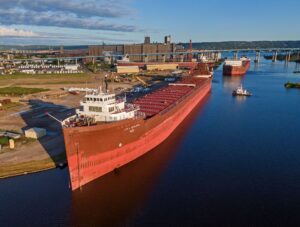
M/Vs Lee A. Tregurtha and Stewart J. Cort coming into Fraser Shipyards in Howards Bay, a hub for maritime commerce, historical sawmill and grain industries for more than a century. The only U.S. shipyard above the Soo Locks and largest grain elevator in the Duluth-Superior Harbor are located here. Photo Credit: David Schauer

The Great Lakes Legacy Act dredging project in Howards Bay is complete, marking a key milestone in pollution cleanup in the St. Louis River Area of Concern (AOC). Howards Bay is an industrial bay in the City of Superior, Wisconsin that’s important for Great Lakes commerce.

The project was performed in partnership with the Wisconsin Department of Natural Resources, Fraser Shipyards Inc., the City of Superior, and U.S. Environmental Protection Agency in coordination with U.S. Army Corps of Engineers. The $21.5 million project in the St. Louis River AOC was funded through the Great Lakes Restoration Initiative with in-kind and cash contributions from the non-federal partners.

84,660 cubic yards of sediments contaminated with lead, mercury, tributyltin and polycyclic aromatic hydrocarbons were removed from Howards Bay and the three slips located within it. Maintenance dredging in the Federal Navigational Channel removed approximately 34,000 cubic yards of sediment.

The completed project provides a healthier aquatic habitat that will improve the overall health of the St. Louis River. It also clears the way for future maintenance dredging to accommodate large vessels entering the shipyard, which had previously been restricted due to contamination in Howards Bay.

Dredged materials that met strict environmental safety criteria were placed on the closed Wisconsin Point Landfill to improve the function and slope of the landfill cap. The dredged materials are covered with six inches of clean material from the U.S. Army Corps of Engineers’ Erie Pier facility and then topped with six additional inches of topsoil to help establish native vegetation.

The landfill is being stabilized with hydro-mulch to protect the surrounding environment until permanent vegetation is established in the spring. As part of the project, the City of Superior plans to open the former landfill to the public as a natural area complete with gravel trails, benches and a pavilion.

To learn more about the project click here.

To learn more about the St. Louis River AOC click here.

DNR Awards Brownfields Grant To City Of Beaver Dam

The Wisconsin Department of Natural Resources (DNR) has awarded a Brownfields Grant to the City of Beaver Dam to assist with the investigation of potential environmental contamination at the site of a former auto dealership and repair shop.

The grant is from the DNR’s Wisconsin Assessment Monies program, which provides contractor services worth up to $35,000 for the environmental assessment of eligible brownfields sites.

Continue reading “DNR Awards Brownfields Grant To City Of Beaver Dam”

New Community Resource For Vapor Intrusion Evaluation

The Wisconsin Department of Natural Resources (DNR) is now offering an online resource tool for local governments, neighborhood associations and property owners to evaluate sources and minimize the risks of vapor intrusion from historical dry-cleaning operations in their communities.

For much of the 1900s, dry cleaning was a common business especially in Iarge cities where the service could be found on almost every commercial block. The disposal or spilling of cleaning solvents used by historical dry cleaners, long before current waste management laws were in effect, may have resulted in chemical vapors in the ground that can migrate into present-day buildings.

Continue reading “New Community Resource For Vapor Intrusion Evaluation”

DNR Awards Brownfields Grant To City Of Altoona

The Wisconsin Department of Natural Resources (DNR) today announced the department awarded a Brownfields Grant to the City of Altoona.

The grant is from the DNR’s Wisconsin Assessment Monies program, which provides contractor services worth up to $35,000 for the environmental assessment and cleanup of eligible brownfields sites.

Brownfields are abandoned, idle and underused commercial or industrial properties where reuse is stalled by potential contamination. Brownfields vary in size, location, age and past use; they can be anything from a 500-acre former automobile assembly plant to a small, abandoned gas station.

Continue reading “DNR Awards Brownfields Grant To City Of Altoona”

Now Available: Publication RR-0126, Guidance for Sediment-Related Continuing Obligations for Environmental Protection, Wis. Stat. § 292.12(5m) and Publication RR-0117, Guidance: When Should a Site Investigation Enter Surface Water?

Following a public comment period and consideration of the comments received, the publications RR-0126, Guidance for Sediment-Related Continuing Obligations for Environmental Protection, Wis. Stat. § 292.12(5m) and RR-0117, Guidance: When should a site investigation enter surface water? are now posted and available online.

The documents can be found here: RR-0126 and RR-0117. Additional documents and guidance from the Remediation and Redevelopment Program may be found using the search tools available on the publications and forms webpage.

Continue reading “Now Available: Publication RR-0126, Guidance for Sediment-Related Continuing Obligations for Environmental Protection, Wis. Stat. § 292.12(5m) and Publication RR-0117, Guidance: When Should a Site Investigation Enter Surface Water?”

Reminder: Issues & Trends Webinar Next Week: Vapor Intrusion – Revised Guidance, Recent Training and Rule Reminders

The Remediation and Redevelopment (RR) Program reminds you that the next webinar in the Issues & Trends series will take place next week, on November 16, 2021, from 12:00 p.m. to 1:00 p.m.

The scheduled presentation is: Vapor Intrusion – Revised Guidance, Recent Training and Rule Reminders.

Continue reading “Reminder: Issues & Trends Webinar Next Week: Vapor Intrusion – Revised Guidance, Recent Training and Rule Reminders”

DNR Awards Brownfields Grant To Village Of Johnson Creek

The Wisconsin Department of Natural Resources (DNR) today announced the department awarded a Brownfields Grant to the Village of Johnson Creek.

The financial award is from the DNR’s Wisconsin Assessment Monies program, which provides contractor services worth up to $35,000 for the environmental assessment and cleanup of eligible brownfields sites.

Continue reading “DNR Awards Brownfields Grant To Village Of Johnson Creek”

New Online Form To Report Hazardous Substance Discharges

An online form is now available from the Remediation and Redevelopment (RR) Program to report the discovery of hazardous substances identified through sampling. The Notification for Hazardous Substance Discharge Form – Non-emergency Only (4400-225) is now a web-based form found on the RR Program Submittal Portal.

Form 4400-225 should be used to report the discovery of a discharge that is identified through laboratory analysis of soil, water, sediment, vapor or indoor air. Hazardous substance discharges must be reported immediately according to Wis. Stat. § 292.11.

Continue reading “New Online Form To Report Hazardous Substance Discharges”

Issues & Trends Webinar on November 16, 2021: Vapor Intrusion – Revised Guidance, Recent Training and Rule Reminders

The Remediation and Redevelopment (RR) Program reminds you that the next webinar in the Issues & Trends series will take place on Tuesday, November 16, 2021, from 12:00 p.m. to 1:00 p.m.

The scheduled presentation is: Vapor Intrusion – Revised Guidance, Recent Training and Rule Reminders.

Continue reading “Issues & Trends Webinar on November 16, 2021: Vapor Intrusion – Revised Guidance, Recent Training and Rule Reminders”