Semi-annual reporting for the period of July 1, 2020 to December 31, 2020 is due by January 30, 2021. Semi-annual reporting is required of responsible parties (RPs) for all open sites, including those sites the DNR formerly classified as “conditionally closed” in the BRRTS online database. Consultants may submit these reports on behalf of RPs.
Cleanup
Contaminated Sediments EAG to Meet Nov. 17 Regarding Financial Assurance
The Remediation and Redevelopment Program will host an online meeting of the Contaminated Sediments External Advisory Group (EAG) on Tuesday, November 17th from 3:00 to 5:00.
This is an opportunity to provide feedback on proposed rules for calculating financial assurance when engineering controls are used to address contaminated sediment left in place.
Continue reading “Contaminated Sediments EAG to Meet Nov. 17 Regarding Financial Assurance”
Updated VPLE Insurance Fees
The Voluntary Party Liability Exemption (VPLE) Insurance fee schedule (RR-661) is now updated and available on the DNR website.
The VPLE program allows a party to conduct an assessment and remedial action of an entire property with DNR oversight to obtain a liability exemption. Insurance is required for VPLE sites where groundwater contamination levels are above enforcement standards and the DNR determines that natural attenuation will restore groundwater quality.
DNR Awards Brownfields Grant Valued up to $35,000 to Grant County
An abandoned downtown property in Lancaster with a 25-year history of petroleum contamination is getting closer to being cleaned up and marketable to possible buyers with assistance from a brownfields grant from the Wisconsin Department of Natural Resources (DNR).
Continue reading “DNR Awards Brownfields Grant Valued up to $35,000 to Grant County”
DNR Awards Brownfields Grant Valued up to $35,000 to City of Stoughton Redevelopment Authority
A blighted riverfront property in Stoughton is on the way to being cleaned up with assistance from a brownfields grant from the Wisconsin Department of Natural Resources (DNR).
Monthly PECFA Financial Summaries: March – September, 2020
The Remediation and Redevelopment Program provides updates on the status of the Petroleum Environmental Cleanup Fund Award (PECFA) program claims and the overall PECFA budget.
Please note that the PECFA program ended on June 30, 2020. The “sunset date” is found in Wis. Stat. § 292.63(3)(ac).
The DNR does not have statutory authority to unilaterally change or amend a deadline found in statute as that authority is exclusive to the state legislature.
The monthly financial summaries are as follows:
| Month | Claims | Number | Value |
| March | |||
| Claims Received | 53 | $258,848 | |
| Claims Paid | 14 | $84,777 | |
| Claims in Audit Line (as of 3/31/20) | 86 | $458,357 | |
| Total Paid FY20 | $4,366,043 | ||
| April | |||
| Claims Received | 137 | $745,336 | |
| Claims Paid | 39 | $187,274 | |
| Claims in Audit Line (as of 4/30/20) | 185 | $1,014,502 | |
| Total Paid FY20 | $4,553,317 | ||
| May | Claims Received | 81 | $316,980 |
| Claims Paid | 114 | $502,096 | |
| Claims in Audit Line (as of 5/31/20) | 150 | $797,012 | |
| Total Paid FY20 | $5,055,413 | ||
| June | Claims Received | 278 | $3,006,690 |
| Claims Paid | 22 | $89,254 | |
| Claims in Audit Line (as of 6/30/20) | 356 | $2,750,738 | |
| Total Paid FY20 | $5,114,667 | ||
| July | Claims Received | 38 | $516,072 |
| Claims Paid | 173 | $917,495 | |
| Claims in Audit Line (as of 7/31/20) | 289 | $3,457,844 | |
| Total Paid FY21 | $917,496 | ||
| August | Claims Received | 0 | $0 |
| Claims Paid | 131 | $1,349,346 | |
| Claims in Audit Line (as of 8/31/20) | 148 | $1,939,423 | |
| Total Paid FY21 | $2,266,824 | ||
| Sept. | Claims Received | 0 | $0 |
| Claims Paid | 126 | $1,503,132 | |
| Claims in Audit Line (as of 9/30/20) | 18 | $361,784 | |
| Total Paid FY21 | $3,769,956 | ||
Brownfields Multipurpose, Assessment and Cleanup Grant Applications Due October 28, 2020; EPA Region 5 Application Webinar on September 23
The U.S. Environmental Protection Agency is now accepting applications for FY21 Brownfields Multipurpose, Assessment & Cleanup (MAC) Grants. All applications are due October 28, 2020.
Grants awarded by the EPA’s Brownfield Program provide communities across Wisconsin and the country with an opportunity to transform contaminated sites into community assets that attract jobs and achieve broader economic development outcomes while taking advantage of existing infrastructure. In many cases, brownfields grants have been shown to not only increase local tax revenue, but to also have a positive impact on residential property values.
EPA Brownfields Awards to Three Wisconsin Communities
Three Wisconsin communities will receive a total of $2.1 million in brownfields awards. The grants come from the U.S. Environmental Protection Agency’s (EPA) ARC Grants Programs – Assessment, Revolving Loan Fund and Cleanup. Green Bay and Washington County both stand to receive $800,000; Brillion will receive $500,000.
The grants will provide those communities with needed assistance as they work to transform contaminated sites into community assets that attract jobs and achieve broader economic development outcomes.
Continue reading “EPA Brownfields Awards to Three Wisconsin Communities”
Natural Resources Board Considers Emergency Rule May 27
On May 27, 2020, the department will present proposed emergency rules to the Natural Resources Board (NRB) for adoption. The proposed emergency rules implement statutory financial assurance requirements that apply to certain types of sites with contaminated sediment. When available, the proposed emergency rule board order RR-11-17E will be posted online as part of the NRB’s agenda.
Continue reading “Natural Resources Board Considers Emergency Rule May 27”
Wisconsin DNR Offers Environmental Compliance Roadmap – All state laws and regulations remain in effect
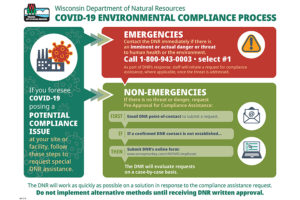
Wisconsin DNR Environmental Compliance Roadmap
Under Gov. Evers’ Safer at Home order the Wisconsin Department of Natural Resources will prioritize responding to imminent threats or complaints related to public health, safety and the environment over routine, on-site audits and inspections.
The regulated community can go here for a one-stop location to request case-by-case assistance due to likely compliance issues associated with COVID-19. All state laws and regulations remain in effect, unless otherwise suspended by the governor.
The DNR is committed to doing what we can to help those impacted by COVID-19 while continuing to protect environmental quality, public health and safety. The DNR is sensitive to the challenges posed to its regulated community, such as wastewater and air permittees and landfill license holders.
All entities should make every effort to comply with their environmental compliance obligations. Where full compliance may not be possible due to COVID-19, the DNR created an environmental compliance roadmap for regulated entities.
The DNR advises businesses or local governments having a spill or a compliance problem that poses an imminent or actual threat to health or the environment to report it immediately by calling toll free 1-800-943-0003 and selecting “1.” This number is monitored 24 hours a day.
For non-emergency situations, the DNR is providing this online process as a means for the regulated entities to request advance compliance assistance from the DNR. This process should be initiated by directly emailing the main DNR contact for the facility or by using the online web form to request case-by-case compliance assistance.
The DNR will monitor these systems daily during regular business hours. Where safe compliance alternatives are approved in advance by the DNR, regulated entities will be required to maintain records adequate to document implementation of authorized alternative compliance options.
The Wisconsin Department of Natural Resources continues to receive the most up-to-date information and will adjust operations as conditions change. Distance is key during this public health emergency.
Under the Safer at Home order, we must do all that we can to prevent the spread of COVID-19. Staying home as much as possible and limiting travel to your community is the best way to lower COVID-19 infection rates.
This is a rapidly evolving situation. For the latest updates, visit the DNR website or follow @WIDNR on Facebook, @wi_dnr on Instagram, or @WDNR on Twitter.
For specific information regarding the COVID-19 we encourage the public to frequently monitor the DHS website for updates, and to follow @DHSWI on Facebook and Twitter, or dhs.wi on Instagram. Additional information can be found on the CDC website.